Get Quote
Home > News > Fan Knowledge Sharing > DC Compact Fan Advantages and Benefits
DC Compact Fan Advantages and Benefits

DC Compact Fan Advantages and Benefits

AUGUST 24, 2026

Table of Contents

  1. Introduction

  2. Superior Energy Efficiency

  3. Compact Size and High Power Density

  4. Precise Speed Control and Smart Features

  5. Quieter Operation

  6. Longer Lifespan and Reliability

  7. Simplified System Integration

  8. Environmental and Regulatory Benefits

  9. Summary

  10. Frequently Asked Questions

  11. References

1.Introduction

If you have ever wondered why modern electronics run so quietly and reliably despite packing more power into smaller enclosures, a good part of the answer sits on a small circuit board inside a DC compact fan. These brushless DC (BLDC) axial fans have been quietly replacing their AC counterparts in everything from servers and telecom racks to medical devices and 3D printers. The shift is not driven by marketing hype. It is driven by hard numbers: better efficiency, longer life, tighter control, and a smaller footprint [1].

This article lays out the specific advantages of DC compact fans over traditional AC fans, with real data and practical context. Whether you are specifying fans for a new product design or evaluating whether to retrofit an existing cooling system, these are the benefits that actually matter.

2.Superior Energy Efficiency

DC Compact Fan Advantages and Benefits

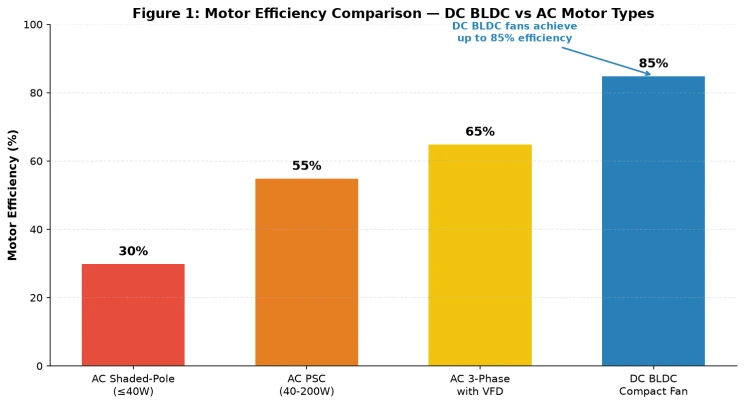
Figure 1: Motor efficiency comparison. DC BLDC compact fans achieve up to 85% efficiency, far exceeding AC shaded-pole (30%) and PSC (55%) motors.

This is the single biggest advantage, and the numbers are striking. A typical AC shaded-pole motor, the kind found in cheap bathroom fans and small appliance coolers, runs at roughly 30% efficiency. That means 70% of the electricity it draws is wasted as heat before any air even moves. A permanent split capacitor (PSC) AC motor does better at around 55%, but a DC BLDC compact fan routinely hits 70 to 85% motor efficiency [6].

Why the gap? AC induction motors lose energy in the rotor through slip (the rotor always spins slightly slower than the magnetic field driving it), copper I2R losses in the rotor bars, and core losses from the laminated iron stack. BLDC motors eliminate rotor slip entirely because the rotor uses permanent magnets. The electronic commutation also optimizes the switching timing across the entire speed range, something AC motors cannot do [3].

At the system level, the savings compound. A data center running 50 DC compact fans instead of AC equivalents can save 30,000 kWh or more annually [5]. The U.S. Department of Energy has identified motor system efficiency upgrades as one of the most cost-effective energy conservation measures available to industry [6].

Where the efficiency matters most:
Battery-powered devices: every watt saved extends runtime directly
Data centers: cooling fans run 24/7, so even 5% efficiency gains compound
Industrial enclosures: lower heat generation means less secondary cooling needed [5]
Energy Star certified products: DC fans help meet strict idle power limits [8]

3. Compact Size and High Power Density

DC Compact Fan Advantages and Benefits

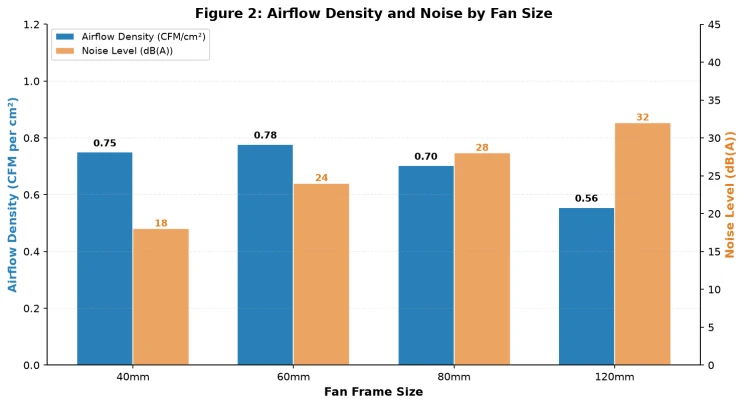
Figure 2: Airflow density (CFM per square centimeter of frame area) and noise levels across common DC compact fan sizes.


DC compact fans pack more airflow into less space than any AC fan can match. A 40 mm DC fan moving 12 CFM takes up roughly 16 square centimeters of panel space. To get the same airflow from an AC fan, you would need a much larger frame because AC induction motors are physically bigger for the same output [1].

This matters enormously in modern product design, where every millimeter counts. Laptop cooling systems, 1U server chassis, LED light engines, and portable medical devices all rely on DC compact fans precisely because they deliver serious airflow in packages as small as 25 mm square and 10 mm thick [2].

The power density advantage comes from the BLDC motor design. Permanent magnets generate a stronger magnetic field per unit volume than induction, so the motor can be smaller for the same torque output. The integrated electronics also eliminate the external VFD or speed controller that an AC fan would need, freeing up even more space [3].

4. Precise Speed Control and Smart Features

DC compact fans offer speed control granularity that AC fans simply cannot match. The built-in driver IC accepts a PWM (pulse width modulation) signal and adjusts speed from roughly 15% to 100% of maximum, with smooth transitions and no stalling [4].

Compare this to an AC fan, where speed control typically requires an external VFD that costs $200 to $800, adds wiring complexity, and introduces harmonic distortion into the power supply [7]. With a DC compact fan, the control is built in. You send a 25 kHz PWM signal, and the fan does the rest.
Built-in smart features that AC fans lack:

Tachometer output: Real-time RPM feedback for monitoring and fault detection [1]
PWM speed control: Precise duty-cycle-based speed adjustment from 15% to 100% [4]
Auto-restart: Some models automatically restart after a temporary blockage clears
Current limiting: Built-in protection against stall-induced overcurrent
Temperature-based auto-control: Some fans include a thermistor input for autonomous speed adjustment without an external controller [2]
These features matter most in mission-critical applications. A server chassis can monitor every fan's tachometer signal and instantly detect if one fails, then ramp up redundant fans to compensate. ASHRAE thermal guidelines for data centers emphasize the importance of fan monitoring and redundancy for maintaining safe operating temperatures [5].

5. Quieter Operation

Noise is not just a comfort issue. In many environments, it is a regulatory requirement. Office spaces, hospitals, recording studios, and residential buildings all have specific noise limits that cooling fans must meet. DC compact fans have a distinct advantage here.

A typical 80 mm DC compact fan produces 28 dB(A) at full speed. An equivalent AC fan produces 35 dB(A) or more. Since the decibel scale is logarithmic, that 7 dB difference means the AC fan sounds roughly twice as loud [2].

Why DC compact fans are quieter:

Electronic commutation produces smoother torque delivery than AC induction, eliminating the 50/60 Hz hum [3]
No brushes means no brush-on-commutator noise (a problem with older brushed DC motors)
Higher efficiency allows the fan to run at lower RPM for the same airflow, reducing tip noise
PWM control means the fan can idle at 20% speed during light loads, dropping noise below 20 dB(A) [4]
The ability to throttle back to near-silent operation during light loads is a game-changer for consumer electronics. A gaming PC that roars at 45 dB(A) under load can drop to barely audible 22 dB(A) when browsing the web, all because the DC fans can spin down to 800 RPM without stalling [1].

6. Longer Lifespan and Reliability

DC Compact Fan Advantages and Benefits

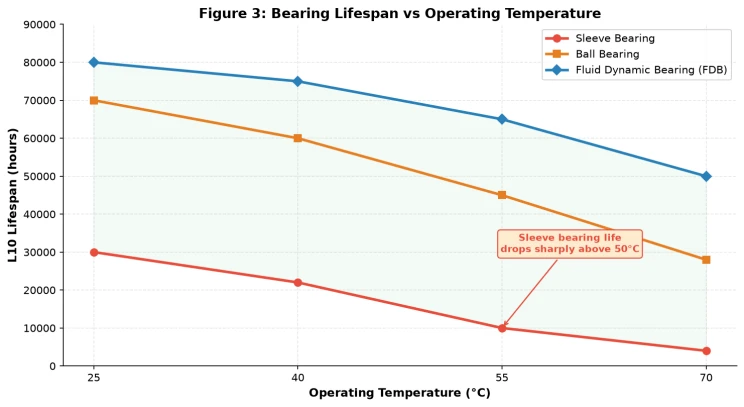
Figure 3: Bearing lifespan versus operating temperature. The advantage of ball bearings and FDB bearings over sleeve bearings widens dramatically at elevated temperatures.

Fan lifespan is determined almost entirely by the bearing, and this is where DC compact fans pull ahead. The key factor is not the motor technology itself but the operating conditions it enables: DC compact fans run cooler and can slow down when full speed is not needed, which extends bearing life significantly [7].

A sleeve bearing AC fan running at 60 degrees Celsius might last 10,000 hours. A ball bearing DC compact fan at the same temperature can run 45,000 hours. A fluid dynamic bearing (FDB) model can exceed 65,000 hours at that temperature [7]. For context, 50,000 hours is about 5.7 years of continuous 24/7 operation.

What makes DC compact fans more reliable:

BLDC motors have no brushes to wear out, eliminating the most common failure mode of brushed DC motors [3]
Lower operating temperatures (less wasted heat) extend bearing lubricant life
Speed control means the fan does not run at maximum stress 24/7 when it does not need to [2]
Tachometer feedback enables predictive maintenance: the system detects speed drops before failure [1]
Premium FDB bearings, available primarily in DC compact fans, offer the longest service life at elevated temperatures [7]
Sunon and other manufacturers publish L10 life curves showing expected lifespan at various temperatures. L10 means 10% of fans will have failed by that point, which is the standard reliability metric for fan bearings [7].

7. Simplified System Integration

DC Compact Fan Advantages and Benefits

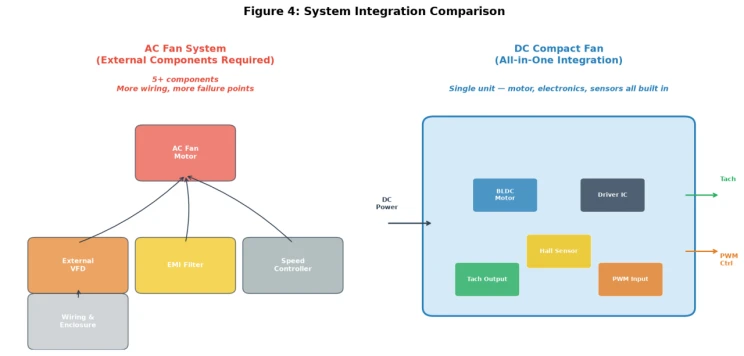
Figure 4: System integration comparison. A DC compact fan integrates motor, driver electronics, and sensors in one unit, while an AC fan system requires multiple external components.

From a design engineer's perspective, one of the most underrated advantages of DC compact fans is how much simpler they make the overall system. An AC fan that needs speed control requires: the fan itself, an external VFD, an EMI filter to suppress switching noise, a separate speed controller, and additional wiring and enclosure space to house all of it [7].

A DC compact fan integrates everything into one unit. The motor, driver IC, Hall-effect sensor, tachometer output, and PWM input are all on a single PCB inside the fan housing. You connect DC power and a control signal, and you are done. No VFD, no EMI filter, no separate controller box [1].

Integration benefits that compound across a product line:

Fewer components means fewer failure points and lower assembly cost
Less wiring means faster manufacturing and simpler service
Smaller overall system footprint (no external drive enclosure needed)
Standardized interfaces (0-10V, PWM, tachometer) work across manufacturers [4]
AMCA-certified performance data ensures specifications are comparable across brands [4]

8. Environmental and Regulatory Benefits

DC Compact Fan Advantages and Benefits

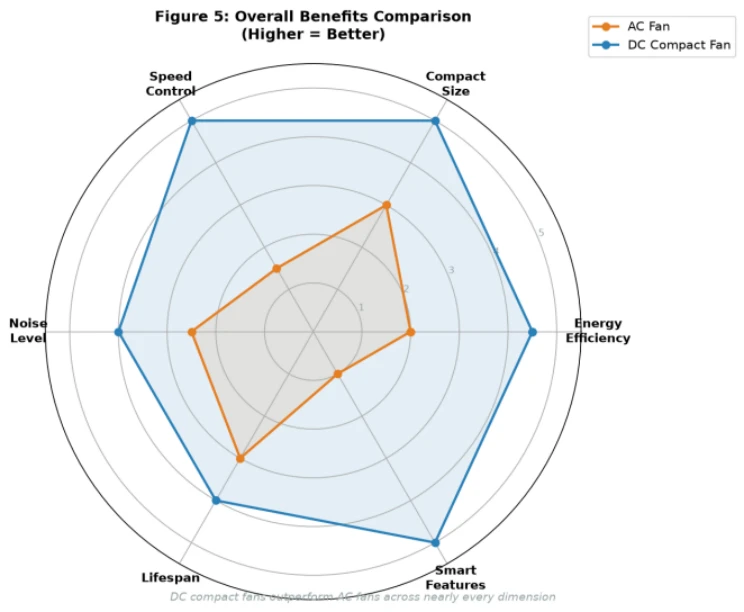
Figure 5: Overall benefits comparison between AC and DC compact fans across six key performance dimensions.

The efficiency advantages of DC compact fans translate directly into environmental benefits. Lower power consumption means lower carbon emissions from electricity generation. Longer lifespan means fewer replacement units ending up in landfills. And because BLDC motors do not use the rare materials that some AC motor designs require for starting capacitors, the material footprint per fan-year of service is lower [6].

Regulatory frameworks are increasingly favoring DC fan technology. Energy Star specifications for electronic equipment set strict idle and standby power limits that are difficult to meet with AC fans running at full speed. The DOE has noted that motor-driven systems account for roughly 70% of industrial electricity consumption, making efficiency upgrades a priority conservation measure [6]. EU Ecodesign directives also push manufacturers toward higher-efficiency motor technology [8].

Specific regulatory advantages:

Energy Star compliance: variable-speed DC fans help products meet idle power limits [8]
ASHRAE 90.1 compliance: efficient fans contribute to building energy code requirements [5]
Lower standby power: DC fans can idle at under 1W during light loads
Reduced cooling load: less waste heat from the fan motor means less secondary cooling needed

9. Summary

DC compact fans outperform AC fans across nearly every dimension that matters: energy efficiency (up to 85% vs 30-55% for AC), size and power density, speed control precision, noise, lifespan, and system integration simplicity. The upfront cost premium is real, typically 2 to 3 times the price of an equivalent AC fan, but the total cost of ownership almost always favors DC technology within 1 to 3 years for any application with significant operating hours [1].

The advantages are not marginal. They are the kind of difference that changes product designs, enables smaller enclosures, meets noise regulations that AC fans cannot, and slashes energy bills in applications running thousands of fans around the clock. For most modern electronics cooling applications, DC compact fans are not just the better choice. They are increasingly the only viable choice.

10. Frequently Asked Questions

Q1: How much energy can I save by switching from AC to DC compact fans?

It depends on duty cycle and fan size, but typical savings range from 30 to 60%. A single 120 mm DC fan running 24/7 at 70% speed draws about 220W compared to 350W for an AC fan with VFD at the same airflow. Over a year, that is roughly $137 per fan at $0.12 per kWh. In data centers running dozens or hundreds of fans, the savings compound quickly [6].

Q2: Are DC compact fans more expensive than AC fans?

Upfront, yes. A DC compact fan typically costs 2 to 3 times more than a comparable AC fan. However, if you need speed control, the comparison shifts: an AC fan plus external VFD often costs more than a DC fan with built-in PWM control. And over 3 to 5 years of operation, the energy savings usually exceed the price difference [1].

Q3: Can DC compact fans be used in harsh industrial environments?

Yes. Many manufacturers offer IP54 or IP66 rated versions for dusty or wet environments. Ball bearing models handle temperatures from -10 to +70 degrees Celsius standard, and automotive-grade variants survive -40 to +85 degrees Celsius with vibration-resistant bearings and AEC-Q200 qualified components. For corrosive atmospheres, special coatings are available [2].

Q4: Do DC compact fans produce electromagnetic interference (EMI)?

They do generate some EMI from the high-frequency switching in the driver IC, but reputable manufacturers design their products to comply with FCC Part 15 and CE EMC directives. In practice, EMI from DC compact fans is rarely a problem. For sensitive environments like medical equipment, look for fans with additional shielding and filtered power inputs [3].

Q5: What is the typical lifespan of a DC compact fan?

It depends on the bearing type and operating temperature. Sleeve bearings last 30,000 hours at 25 degrees Celsius but drop to 10,000 hours at 60 degrees. Ball bearings typically run 50,000 to 70,000 hours. FDB bearings can exceed 80,000 hours. The key advantage of DC fans is that speed control lets them run slower when full speed is not needed, which extends bearing life significantly compared to AC fans stuck at 100% [7].

11. References

[1] ebm-papst Group. DC Compact Fans and EC Technology. Available at: https://www.ebm-papst.com.cn/en/
[2] Sanyo Denki. Sanace DC Fan Products and Specifications. Available at: https://products.sanyodenki.com/en/sanace/
[3] IEEE. Neethu, U. and Jisha, V.R. (2012). "Speed control of brushless DC motor: A comparative study." International Conference on Power, Signals, Controls and Computing (EPSCICON). Available at: https://standards.ieee.org/
[4] AMCA International. Fan Performance Standards and Certification. Available at: https://amca.org/
[5] ASHRAE. Thermal Guidelines for Data Processing Environments and Standard 90.1. Available at: https://www.ashrae.org/
[6] U.S. Department of Energy. Motor Systems Energy Efficiency. Available at: https://www.energy.gov/eere/amo/motor-systems
[7] Sunon. DC Fan Bearing Technology and L10 Life Data. Available at: https://www.sunon.com/en/
[8] Energy Star. Energy Efficiency Guidelines for Electronic Equipment. Available at: https://www.energystar.gov/