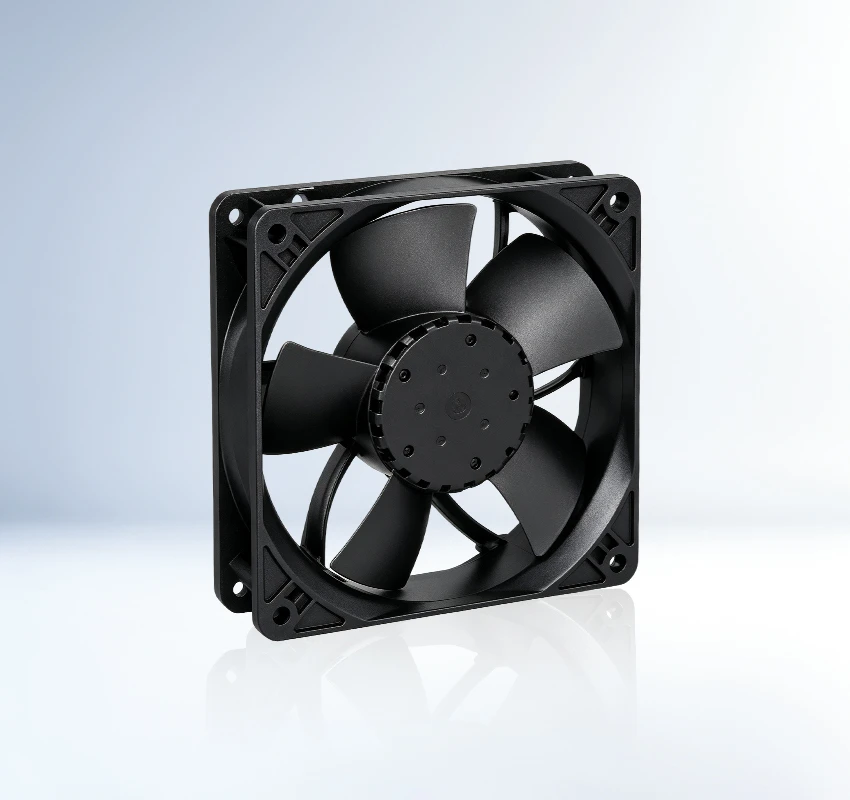
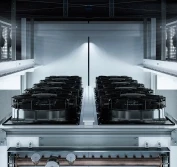
Within servers and data-center equipment, Sanyo Denki 9GA0924P1H011 operates as a 92 × 92 × 38 mm DC axial fan at 24 VDC. No exact entry appears in the supplied feature table, so bearing, control, and protection details require datasheet confirmation. The supplied row lists 63 dB as an important acoustic selection value.
| Rated Voltage(V) | 24 |
|---|---|
| Size(mm) | 92*92*38 |
| Max.Air Flow(m³/h) | 239.7 |
| Max.Pressure(Pa) | 500.7 |
| Input Power(W) | 26.4 |
| Speed(rpm) | 9700 |
| Noise(db) | 63 |
The San Ace 9GA0924P1H011 serves servers, storage systems and ICT equipment as a DC axial fan. Its airflow supports heat transfer from internal devices toward cabinet or chassis exhaust openings.
With up to 239.7 m3/h airflow and 500.7 Pa static pressure, the model can move cooling air through vents, filters and compact internal passages. Buyers should confirm the complete suffix, connector, sensor output and control option before ordering. Engineers should validate the operating point with the actual grille and filter.
Confirm the operating environment for the suffix. The review links cooling performance to the approved BOM. Confirm the final fan curve in the assembled equipment. Preserve clear inlet and outlet space during installation.
The San Ace 9GA0924P1H011 supports thermal management in server chassis and computing nodes. These systems need continuous heat removal because compact layouts and rising power density restrict natural convection. It supports reliable OEM equipment cooling.
For storage arrays and data appliances, 9GA0924P1H011 provides a dedicated forced-air cooling path. These systems need continuous heat removal because compact layouts and rising power density restrict natural convection. It supports reliable OEM equipment cooling.
SANYO DENKI 9GA0924P1H011 serves network and other ICT hardware that operate with sustained internal heat. These systems need continuous heat removal because compact layouts and rising power density restrict natural convection. It supports reliable OEM equipment cooling.
Review ambient temperature, airflow restriction, contamination exposure, noise limit, mounting orientation, and maintenance access.
The worksheet lists 239.7 m³/h. Compare the operating point with system resistance and the official performance curve.
Availability and lead time can change. Confirm the exact suffix, quantity, and delivery date with the supplier before ordering.
The worksheet lists 63 dB. Enclosure acoustics, system resistance, and distance can change the installed result.
Verify supply, connector, obstructions, impeller movement, and alarm or protection status using the model-specific troubleshooting data.
Confirm connector and mounting details, keep the airflow path clear, and isolate power before cleaning or service.